
Mental Health Service Dogs open doors for people with psychological disabilities.
Unleash Your Potential.
Suzie, Heeling Allies Mental Health Service Dog
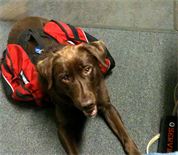 Imagine having a dog that could help you become a part of the world again.
Heeling Allies specializes in privately training Mental Health Service Dogs for qualified individuals with neurological disorders, mental illness, developmental disorders, intellectual disorders, and other psychological conditions that rise to the level of a disability.
Enhanced Quality of Life and Personal Freedom.
Heeling Allies Service Dogs are highly trained to enhance the lives of their handlers by helping them to live independently. Each Heeling Allies Service Dog is tailor trained to meet the specific needs of the individual with whom they will be placed. These talented dogs are trained to help their handlers within the home, as well as outside of the home.
Heeling Allies, Mental Health Service Dogs are trained to perform tasks that help ease debilitating symptoms of some psychological impairments.
Disabilities served include, but are not limited to, Posttraumatic Stress Disorder (PTSD), Acute Anxiety Disorder, Panic Disorder, Agoraphobia, Obsessive Compulsive Disorder (OCD), Generalized Anxiety Disorders, Mood Disorders, Asperger Syndrome, and Tourette Syndrome.
Listed below are examples of some of the many tasks Mental Health Service Dogs can be trained to do for their handler.
- Assist handler within their home.
- Assist handler in places of public accommodation (e.g. grocery stores, shopping malls, public transportation, and etc.).
- Remind their handler to take medication.
- Wake handler for school or work.
- Assist in coping with emotional overload by bringing handler into the “here and now.”
- Provide a buffer or a shield for the handler in crowded areas by creating a physical boundary.
- Extinguish flashbacks by bringing handler into the here and now.
- Orient during panic/anxiety attack.
- Stand behind handler to increase feelings of safety, reduce hyper-vigilance, and decrease the likelihood of the handler being startled by another person coming up behind them.
- Search dwelling.
Many of the benefits to owning a Service Dog extend beyond having the dog’s assistance with certain tasks. Such benefits are inherent in the human-canine relationship and often include:
- Relief from feelings of isolation.
- An increased sense of well-being.
- Daily structure and healthy habits.
- An increased sense of security.
- An increased sense of self-efficacy.
- An increased sense of self-esteem.
- An increased sense of purpose.
- Mood improvement, and increased optimism.
- A secure and uncomplicated relationship.
- A dependable and predictable love, affection and nonjudgmental companionship.
- Motivation to exercise.
- Encouragement for social interactions.
- Reduction in debilitating symptoms.
- Greater access to the world.
- Around the clock support.
Training Matters
Careful. Extensive. Quality. Unparalleled.
 Heeling Allies Mental Health Service Dogs extensive formal training before being paired with a recipient. While in training, these special dogs learn to master advanced obedience skills, specialized task training and public access skills, so that upon graduation they are prepared help their handlers where and when they need it most.
“Now I can go freely into stores once again and not feel as if everyone is pressing in around me. People automatically give us a wider berth and when it does get crowded, Blue presses up against me which automatically turns my attention to him rather than the crowds. I had forgotten what this type of freedom felt like.”
– L.R., and Heeling Allies Service Dog, Blue.
Is there is difference between a Psychiatric Service Dog and a Mental Health Service Dog?
Heeling Allies uses the term, Mental Health Service Dog over Psychiatric Service Dog for a several reasons. The word psychiatric carries a lot of stigma. We have found that a large percentage of people who have mental illness have an aversion to this word, since the word is often associated with deprecating words like, psycho, psychopath, psychotic, crazy and etcetera.
In 2008, Darcie Boltz coined the term Mental Health Service Dog because she felt moved to developing a solution-focused term for this category of service dog.
Other categories of service dogs are modified according to the type assistance the dog provides it’s handler (i.e. guide dog or seeing-eye dog, mobility support dog, hearing dog, seizure alert dog, diabetic alert dog and so on).
Unlike the term, psychiatric service dog, other categories of service dogs are modified according to the type assistance the dog provides it’s handler (i.e. Guide Dog or Seeing-Eye Dog, Mobility Support Dog, Hearing Dog, Seizure Alert Dog, Diabetic Alert Dog and so on). The term, Mental Health Service Dog suggests the dog assists it’s handler in achieving mental health.
Heeling Allies encourages individuals to use the term they feel most comfortable with, whether it is, Mental Health Service Dog, Psychiatric Service Dog, or simply, Service Dog. Although, we have noticed the term, Mental Health Service Dog is gaining in popularity and we are pleased that this is so.
Heeling Allies is located in Seattle WA, and trains Mental Health Dogs for individuals nationally.
Currently Serving: Washington State & Upstate New York